
- News
- Events
- Oneg Shabbat
- Collections
- Research
- Exhibitions
- Education
- Publishing Department
- Genealogy
- About the Institute
- Bookstore

“Intimate Memory, Institutional Memory: Reframing Holocaust Commemorations” – International Conference
Date: 15–17 November 2026
Venue:
Day 1: Conference Room in Blue Tower, Jewish Historical Institute, 2 Bankowy Square, Warsaw, entrance from 3/5 Tłomackie Street, Warsaw
Days 2 & 3: Conference Room at the German Historical Institute, 39 Aleje Ujazdowskie, Warsaw, entrance from the gate
Language: English
Registration: required. Register here: https://forms.gle/cqSG6JXYyQmBsCGo9
Contact for organisational matters: conference@jhi.pl
On 15–17 November 2026, the Jewish Historical Institute will hold an international conference titled “Intimate Memory, Institutional Memory: Reframing Holocaust Commemorations”. The conference will be devoted to the interplay between personal and family memory of the Holocaust and the memory shaped by states.
Memorials to the Holocaust and crimes committed during the Second World War started to appear even before 1945. With time, their forms began to change, as did their intended purpose. Some memorials served primarily to honour tragic events and their victims, while others built a particular narrative of the past, with politics often clashing with memory and history. All this led to the development of numerous commemorative forms, which will be discussed by the speakers at the conference. The keynote lecture, devoted to commemorative practices and counter-memorials to the Holocaust, will be delivered by Natalia Romik of Wissenschaftskolleg zu Berlin.
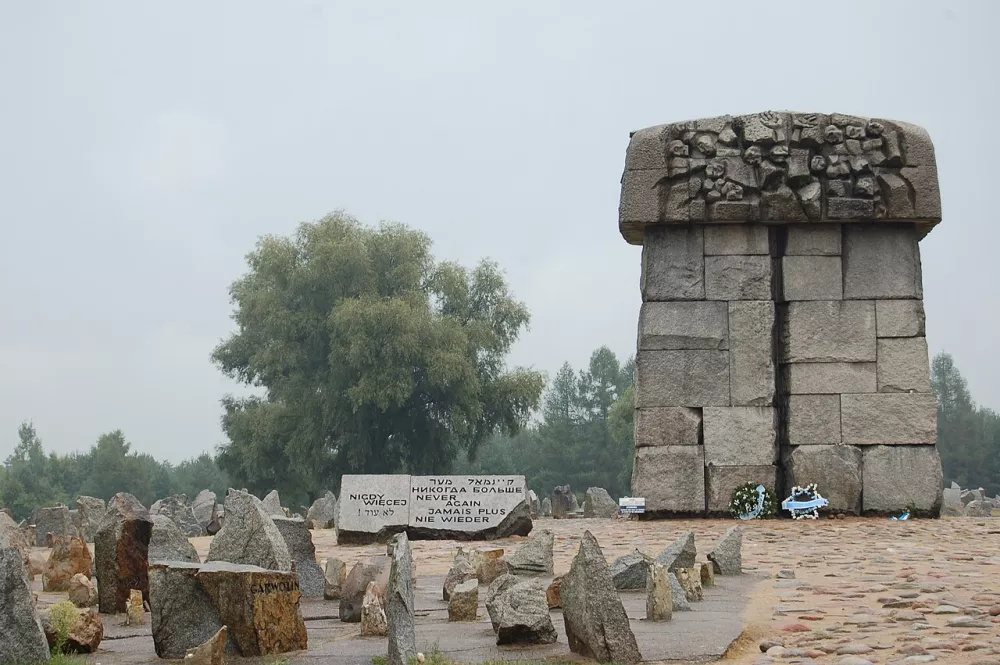
One of the most iconic and widely recognised memorials to the Holocaust is the one designed by Adam Haupt, Franciszek Duszeńka, and Franciszek Strynkiewicz, erected at the site of the former death camp Treblinka II. The conference itself is organised in connection with the upcoming permanent exhibition at Treblinka Museum, created by the Jewish Historical Institute. The exhibition project will be presented at the end of the conference proceedings.
Program
Day 1, November 15, 2026
14:00–15:30 Opening / Panel I. Grassroots and Local Commemorative Initiatives
Anna Berezin, Hebrew University of Jerusalem, Holocaust Commemoration by Townmates’ Communities: Between Local and Global
Susanne Barth, University of Stockholm, Holocaust Commemoration by a Polish Grassroots Initiative: The Example of the Blechhammer-1944 Association
Orit Stieglitz, Bardejov Jewish Preservation Committee, Holocaust Remembrance in Bardejov, Slovakia: Intersections of Restoration, Education, and Commemoration
16:00–17:30 Panel II. Memory Politics: Local – National – Transnational
Anna Zadora, University of Strasbourg, Authoritarian Necro-Amnesia: When Institutional Memory Erases Intimate Holocaust Remembrance in Belarus
Zofia Wóycicka, University of Łódź / German Historical Institute in Warsaw, A Beech Tree for the Righteous: On the Interplay between Local, National and Transnational Memory Politics
Natalia Krzyżanowska, Örebro University, Remembering in a Country without Memory? Holocaust Commemoration in Sweden
18:00–19:30 Keynote Lecture:
Natalia Romik, Wissenschaftskolleg zu Berlin, Glass Monuments, Unveiled Hideouts, Nomadic Archives, and Commemorations Made of Salt: Memory Practices and Counter-Monuments in Holocaust Commemoration.
Day 2, November 16, 2026
10:00–11:30 Panel III. Objects and Private Spaces as Carriers of Intimate Memory
Magdalena Waligórska, Humboldt-Universität zu Berlin, Material Objects of Holocaust Dispossession as Vehicles of Intimate Memory within the Beneficiary Communities: Digital Crowdsourcing Platform Przechowane.org
Maria Kaspina, Central Archives for the History of the Jewish People in Jerusalem, The Afterlife of Abandoned Things: Property, Loss, and Intimate Memory in Holocaust Survivor Testimonies
Marta Duch-Dyngosz, Humboldt-Universität zu Berlin, Jewish Homes – Abandoned, Plundered, Expropriated and Re-inhabited – Agents of Memory of the Holocaust in Small Towns and Villages in Present-day Poland
12:00–13:30 Panel IV. Remains, Mourning, Commemoration
Doron Bar, Schechter Institute of Jewish Studies, Martyrs’ Ashes and the Commemoration of the Holocaust in the Early Years of the State of Israel
Tomasz Jankowski, Vilnius University, Between Ruined Memorials and Comprehensive Commemorations. Mass Graves in the public Space in Ukraine
Maria Piekarska-Baronet, University of Warsaw, Between Institutional Logic and Private Grief: Remembering the Martyrs’ Forest
14:30–16:00 Panel V. Monuments between Socialist Heritage and Globalization
Arkadi Zeltser, Yad Vashem, Contemporary Holocaust Monuments in Eastern Europe: Between Soviet Heritage and Globalization
Eva Janáčová, Art History, Czech Academy of Sciences, Holocaust Monuments and Memorials in the Czech Republic
Olga Ungar, Yad Vashem, Between Jewish Memory and Antifascist Commemoration: Visualizing the Holocaust in Yugoslavia
16:30–18:00 Panel VI. Personal Quests, Art and Digital Memory
Leslie Benitah, Independent scholar, When the Witnesses Are Gone: From Family Memory to Digital Memory in Holocaust Commemoration
Marta Kapełuś, Jewish Historical Institute / Polish Academy of Sciences, Józef and Ernestyna Sandel and the Reconstruction of Jewish Artistic Memory in Postwar Poland
09:30–10:30 Panel VII. Jewish Cemeteries and Matzevot as Carriers of Memory
Milda Jakulytė-Vasil, Vilnius University, From Jewish Cemeteries to Mass Murder Sites: Reused Tombstones and Holocaust Memorialization in Soviet Lithuania
Samuel Holleran, University of Melbourne, The Holocaust on Hallowed Ground: Early Memorials in 'New World' Cemeteries
11:00–12:00 Panel VIII. Between Intimate and Institutional Memory
Barry L. Stiefel, College of Charleston, Remembering Without Witnesses: Intimate Memory, Institutional Authority, and the Preservation of Holocaust Commemoration in the American South
Rachel Lehr and Ruth Mandel, University of Colorado / UCL, Intimate and Global Memorialisation: Stolpersteine in Hungary Through an Anthropological Lens
12:00–13:00 Maria Ferenc, Jewish Historical Institute, Presentation of the Upcoming Exhibition at the Treblinka Museum
The conference is organized by the Emanuel Ringelblum Jewish Historical Institute.

In cooperation with:


Co-financed by the Minister of Culture and National Heritage

The conference is made possible through the financial support of the Sue and Leonard Miller Center for Contemporary Judaic Studies at the University of Miami
____
Photo: Treblinka Memorial Monument, Wikimedia Commons


