- News
- Events
- Oneg Shabbat
- Collections
- Research
- Exhibitions
- Education
- Publishing Department
- Genealogy
- About the Institute
- Bookstore

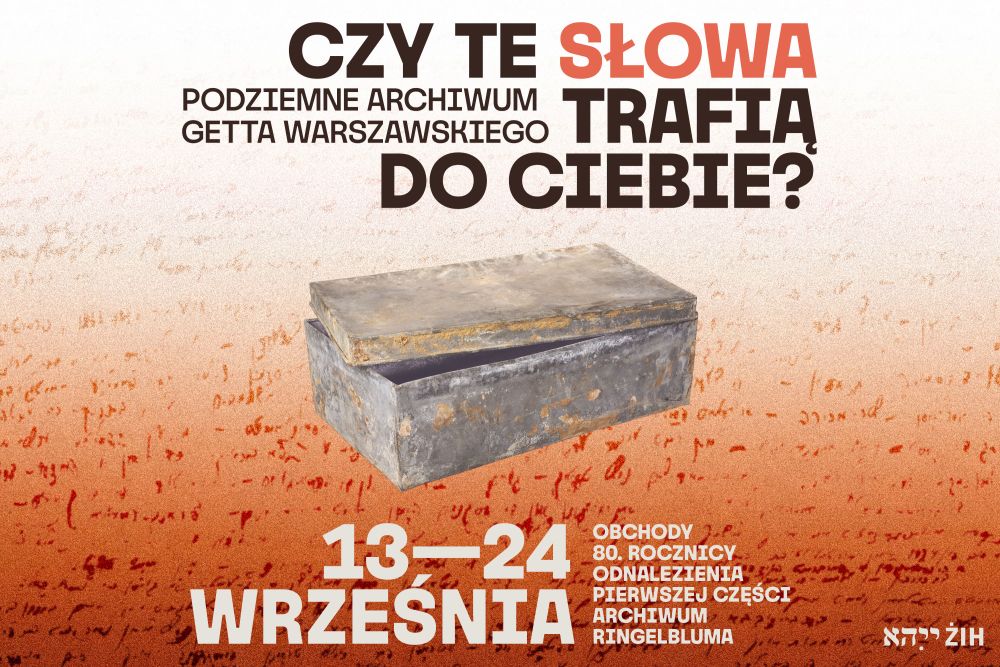
Ten metal boxes, in which members of Oneg Shabbat had hidden the documents, survived underground for nearly four years. The recovered materials have become one of the most important testimonies to the history of Warsaw’s Jews and the Holocaust.
Today, the Ringelblum Archive is housed at the Jewish Historical Institute and has been included on UNESCO’s ‘Memory of the World’ Register since 1999.
In 2026, the Jewish Historical Institute invites you to join us in commemorating the 80th anniversary of the discovery of the first part of the Ringelblum Archive. The anniversary celebrations will be an opportunity not only to tell the story of this extraordinary collection, but also to examine it from various perspectives: through the surviving documents and their physical nature, the history of the post-war search, contemporary research, and personal encounters with the testimonies of Oneg Shabbat.
The centrepiece of the celebrations will be a ceremony at the site where the first part of the Archive was found, at what is now 28/30 Nowolipki Street. The ceremony will be complemented by a concert by Albert Woelke, who will perform Sofia Gubaidulina’s De Profundis (1978) and Mieczysław Wajnberg’s Aria (1942) on the accordion.
The celebrations will also include a performative reading of ‘So that something remains…’, dedicated to the memory of the Ringelblum Archive, scheduled for 13 September. The script will be prepared by Karolina Kirsz, and the invited actors and actresses will present excerpts from documents held in the Archive, as well as material relating to the post-war search for the hidden collection. The juxtaposition of testimonies from the time of the Holocaust with documents concerning the discovery of the Archive will allow us to examine its history as a story of documentation, concealment, search and the preservation of memory.
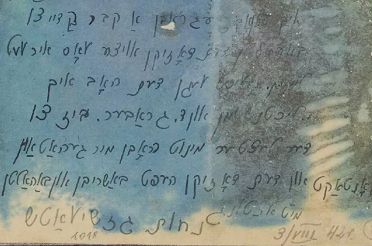
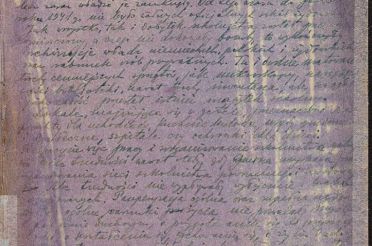
At the Jewish Historical Institute’s headquarters, visitors will also be able to see an exhibition dedicated to the materiality of the Ringelblum Archive. This will offer a glimpse into the physical dimension of the collection – the paper, the handwriting, and the traces of storage and damage.
It is precisely the physical form of the Archive that reminds us that we are dealing not only with the content of historical testimonies, but also with objects that survived the war.
As part of the celebrations, there will also be an academic session entitled ‘What does the Ringelblum Archive mean to us?’. Leading experts will come together to discuss the significance of the Archive from the perspective of contemporary historical research, memory and heritage. We will examine the collection not only as a source of knowledge about the Holocaust, but also as a work created with the future in mind – a testament to the work of Oneg Shabbat, which, 80 years on, continues to raise new questions and interpretations.
The programme will be complemented by special guided tours of the permanent exhibition ‘What we've been unable to shout out the world’, dedicated to the activities of Oneg Shabbat and the history of the Ringelblum Archive. From 14 to 16 September, Dr Eleonora Bergman, Beata Chomątowska and Dr Sylwia Chutnik will lead tours of the exhibition.
On 24 September, there will also be a screening of the film ‘Who Will Write Our History?’, directed by Roberta Grossman. This Polish-American fictionalised documentary tells the story of Emanuel Ringelblum and the Oneg Shabbat group, as well as the creation of the Underground Archive of the Warsaw Ghetto. The film combines archive footage, interviews and dramatised scenes, evoking both the history of the clandestine work to document life in the ghetto and the effort put into preserving these testimonies for future generations. The screening will provide another opportunity to explore the Ringelblum Archive – this time through the medium of film – and to recall the stories of those who took risks to preserve their own account of a world doomed to destruction.
From 18 September, the exhibition 'Will These Words Reach You?The Underground Archive of the Warsaw Ghetto' is open to the public in New York. Exhibition examines one of the most significant acts of Jewish resistance and historical preservation during the Holocaust: the creation of the Oyneg Shabes Archive in the Warsaw Ghetto. After the Nazis sealed the ghetto in November 1940, more than 400,000 Jews were confined under brutal and dehumanizing conditions. Alongside mass starvation, disease, and violence, Jewish life faced cultural and historical annihilation. Within this environment, documenting daily experience became both a risk and a necessity.
The 80th-anniversary commemorations will provide an opportunity to engage with the Archive in its many dimensions: as a collection of documents, a tangible testimony to the past, a subject of research and conservation, and above all — as the voice of people who, during the Holocaust, decided to document the reality in which they lived.
Their work was intended to preserve memory. Eighty years after the discovery of the first part of the Archive, we wish not only to preserve this memory, but also to reinterpret it and pass it on to future generations.
![MKiDN_bialy_logotyp_strona_ŻIH_EN.png [10.32 KB]](https://www.jhi.pl/storage/image/core_files/2023/1/12/0fbb15388d1a5d89c65891b6ce66941c/png/jhi/preview/ZNAK%20ENG.png)