
Menu
- News
- Events
- Oneg Shabbat
- Collections
- Research
- Exhibitions
- Education
- Publishing Department
- Genealogy
- About the Institute
- Bookstore

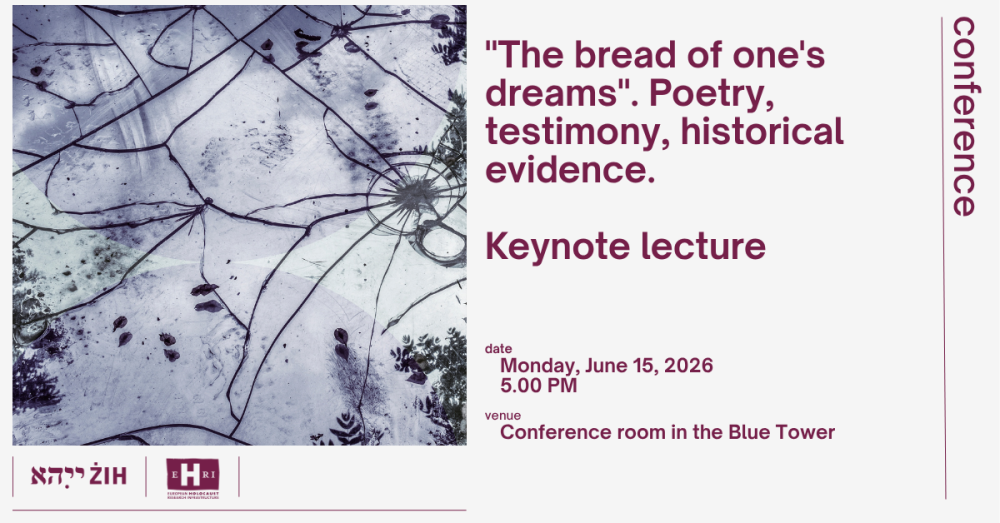
The keynote lecture will take place as part of the international conference ‘Documenting the Holocaust: Testimonies as Historical Evidence’.
Both the conference and the keynote lecture will be conducted in English.
Free admission
Judith Lyon-Caen is a historian and professor at EHESS (School for advanced studies in the social sciences, Paris). Her work focuses on the history of the social uses of literature in the 19th and 20th centuries, and on the relationship between history and literature. Part of her research focuses on 19th and 20th-century France, while the other part examines the use of testimony and literature in early historiographies of the Holocaust (in France and Poland in particular). She is currently the co-director of H-DIARIES (in cooperation with Andrea Löw, IfZ Munich), a German-French research project dedicated to the systematic study of Jewish Holocaust diaries.
Her publications include La Griffe du temps. Ce que l'histoire peut dire de la littérature (2019) and "Balzac nous appartient". Une histoire politique de la transmission littéraire (2026); she is also the French scientific editor of Janina Hescheles' memoirs (with Livia Parnès, 2016) and of Michel Borwicz's works (ed., Ecrits des condamnés à mort sous l'occupation nazie, Paris, Gallimard, 2023)
Keynote lecture: "The bread of one's dreams". Poetry, testimony, historical evidence.
Where is the bread in the expression "the bread of one's dreams" ? And can the reading of a poem by Charles Baudelaire help us better grasp the documentary value of a poem written in the ghetto ?
There are many poems in the collections of Holocaust testimonies—whether in the Ringelblum Archives or other documentary collections. These texts have generally been read either as traces of poetic activity in the face of destruction, or, in some cases, as documents when explicitly framed as such (as with W. Szlengel's 'poems-documents').
Yet the very presence of poetry within testimonial archives raises broader questions for historians: it adresses the more general question of form and formal choice in testimonial writing. Testimony is not only a matter of content but also of formal choices, and historians are not always equipped to analyse these issues. Building on the work of Saul Friedländer and some of Michel Borwicz's proposals, I will call for a greater degree of literary attention in order to better discern the value of these texts as historical evidence, and propose approaches to reading testimonial poems as poems and, precisely as poems, as “sources for history.”
The conference is organized by The Emanuel Ringelblum Jewish Historical Institute
![ŻIH_logo_EN.jpg [62.88 KB]](/storage/image/core_files/2021/1/25/577483e974f1d6a76944a8475e4bb6c5/jpg/jhi/preview/IH_logo_EN.jpg)
In cooperation with
![UF.png [7.33 KB]](/storage/image/core_files/2026/1/23/c6a71c5b860543768efb03f7690ff605/png/jhi/preview/UF.png)
![YV.png [4.55 KB]](/storage/image/core_files/2026/1/23/11ae1c9c952e65cc439b3ed43d5492f2/png/jhi/preview/YV.png)
![centrum badan nad zaglada.png [4.29 KB]](/storage/image/core_files/2026/1/23/8821eca67b16edd9d25bdfcf0b41446a/png/jhi/preview/centrum%20badan%20nad%20zaglada.png)
![wiener wiesenthal.png [4.55 KB]](/storage/image/core_files/2026/1/23/da9d381ac2a1955a08122d94ae1d069d/png/jhi/preview/wiener%20wiesenthal.png)
![Fortunoff.png [4.97 KB]](/storage/image/core_files/2026/1/23/81fba4e81349330d0f4e2866c2f7d3aa/png/jhi/preview/Fortunoff.png)
![Wiener holocaust library.png [5.34 KB]](/storage/image/core_files/2026/1/23/6d0c027bb0a13a2138b5a72605844196/png/jhi/preview/Wiener%20holocaust%20library.png)
Partners of the conference
![polin_SB_PL.jpg [52.24 KB]](/storage/image/core_files/2026/2/6/faf045db7e76c842b0df78b2ac3318ce/jpg/jhi/preview/polin_SB_PL.jpg)
![logo_filhist_CBZ_h_pl_RGB_achromatyczne_Easy-Resize.com.jpg [80.47 KB]](/storage/image/core_files/2026/2/9/e069a10616bb5a7abf4af911b46aba02/jpg/jhi/preview/logo_filhist_CBZ_h_pl_RGB_achromatyczne_Easy-Resize.com.jpg)
The conference is organized within the framework of EHRI-PL and co-funded with resources from the Ministry of Culture and National Heritage for the task ‘Ongoing Activities of the Polish National Node of EHRI-PL – the EHRI-ERIC consortium, implemented by the Emanuel Ringelblum Jewish Historical Institute [JHI] for the years 2025–2027 in cooperation with national partners.’
![logo_MKiDN_ENG.png [87.67 KB]](/storage/image/core_files/2026/2/11/a504e5236d675cbf477dff59533d8850/png/jhi/preview/logo_MKiDN_ENG.png)
![MKiDN_bialy_logotyp_strona_ŻIH_EN.png [10.32 KB]](https://www.jhi.pl/storage/image/core_files/2023/1/12/0fbb15388d1a5d89c65891b6ce66941c/png/jhi/preview/ZNAK%20ENG.png)