
Menu
- News
- Events
- Oneg Shabbat
- Collections
- Research
- Exhibitions
- Education
- Publishing Department
- Genealogy
- About the Institute
- Bookstore

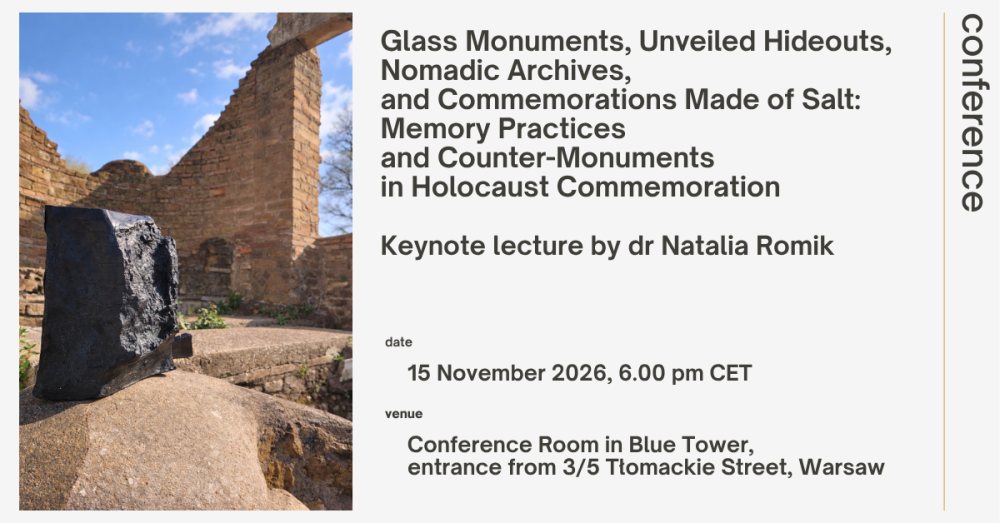
Glass Monuments, Unveiled Hideouts, Nomadic Archives, and Commemorations Made of Salt: Memory Practices and Counter-Monuments in Holocaust Commemoration.
Keynote lecture by dr Natalia Romik
Date: 15 November 2026, 6.00 pm CET
Venue: Conference Room in Blue Tower, Jewish Historical Institute, 2 Bankowy Square, Warsaw, entrance from 3/5 Tłomackie Street, Warsaw
Language: English
This keynote lecture presents Natalia Romik’s artistic, architectural, and research practice devoted to developing new forms of Holocaust commemoration. Working at the intersection of contemporary art, architecture, Jewish studies, archival research, and heritage preservation, Romik proposes a practice of “phantom commemoration”: creating material and spatial forms through which absent buildings, suppressed histories, and hidden sites may become perceptible without being conventionally reconstructed.
The lecture traces this approach through a series of projects developed over nearly two decades. The Glass Bimah in Chmielnik, a full-scale transparent reconstruction of the central platform of the town’s destroyed synagogue, exists between material presence and historical loss. It functions as a monument to the Jewish community that once constituted the majority of Chmielnik’s population, while refusing the illusion that the lost world of the shtetl can simply be rebuilt.
The Nomadic Shtetl Archive transforms the archive into a mobile, reflective architecture that travels through former shtetls towns in Poland and Ukraine. Rather than presenting memory as a closed institutional collection, it invites local inhabitants to become participants, witnesses, and co-researchers, collectively identifying places, photographs, stories, and residues of Jewish life.
Romik will also discuss Hideouts: The Architecture of Survival, a long-term investigation of improvised hiding places built and used by Jews during the Holocaust. Located in cellars, attics, sewers, cemeteries, tree hollows, and other precarious spaces, these fragile architectures challenge dominant definitions of Holocaust heritage. Researching them requires interdisciplinary and site-specific coalitions combining archival, archaeological, architectural, dendrological, speleological, and artistic methods.
Further examples include the temporary glass monuments Without a Shadow, marking bunkers used during the Warsaw Ghetto Uprising, and the Oneg Shabbat Memorial, whose transparent wall commemorates the collective labour of those who documented life and destruction inside the Warsaw Ghetto. The lecture concludes with a proposed memorial in Wieliczka incorporating glass, stone, and locally mined salt. As the salt gradually dissolves and must be replaced by the community, commemoration becomes an ongoing civic practice rather than a finished and immutable object.
These works belong to the traditions of the open monument and the counter-monument. Their purpose is not merely to represent the past, but to unearth concealed memories, redirect established memory practices, and build social coalitions capable of sustaining remembrance over time. In these projects, memory is fragile, participatory, materially unstable, and dependent upon continual acts of attention and care.
Dr Natalia Romik
Graduate in political science, practitioner of architecture, designer, artist. In 2018 Romik was awarded a PhD at the Bartlett School of Architecture at University College London for a thesis Post-Jewish Architecture of Memory within Former Eastern European Shtetls. She combines academic research with methods of contemporary art and architecture to explore the (post)Jewish architecture of memory. Romik has been awarded numerous grants, including the London Arts and Humanities Partnership, Gerda Henkel Stiftung, Maria and Łukasz Hirszowicz Award for academic and artistic activities. From 2007 to 2014, she cooperated with the Nizio Design studio and was a consultant for, among others, the POLIN Museum core exhibition design, co-author of the revitalization of a synagogue in Chmielnik. Romik is a member of the SENNA architecture collective, responsible for designs including the exhibition at the Museum of Jews in Upper Silesia in Gliwice and permanent exhibition at the Brodno Jewish Cemetery in Warsaw entitled “Beit Almin – Eternal Home”. In 2018 she co-curated the exhibition Estranged: March ’68 and Its Aftermath and in 2024 “(post)JEWISH… Shtetl Opatów Through the Eyes of Mayer Kirshenblatt” for POLIN Museum of Polish Jews. Member of the Association of Polish Architects and Jewish Historical Institute Association. Scholarship holder (postdoctoral research) of the Fondation pour la Mémoire de la Shoah (Secret Architecture of Survival: Architectural Anthropology of Jewish Hideouts). Her research concluded with the exhibition Hideouts. The Architecture of Survival, presented in 2022 in Zachęta National Gallery of Art in Warsaw, Trafo Centre for Contemporary Artin Szczecin and Jewish Museum Frankfurt. In 2022 awarded Dan David Prize. Currently a scholarship holder Yehudit and Yehuda Elkana Fellowship in Wissenschaftskolleg zu Berlin
Scientific Committee
Haim Shaked (University of Miami)
Vladimir Levin (Hebrew University of Jerusalem)
Samuel D. Gruber (International Survey of Jewish Monuments)
Michał Trębacz (Emanuel Ringelblum Jewish Historical Institute)
Magdalena Saryusz-Wolska (German Historical Institute in Warsaw)
The conference is organized by the Emanuel Ringelblum Jewish Historical Institute.

In cooperation with:


Co-financed by the Minister of Culture and National Heritage

The conference is made possible through the financial support of the Sue and Leonard Miller Center for Contemporary Judaic Studies at the University of Miami
____
Photo: Natalia Romik, Black Beeswax Candle – Cast of a Brick Fragment from the Staircase of the Former Bersohn and Bauman Children’s Hospital in Warsaw, “Arte in Memoria” 2026, Synagogue of Ostia Antica. Photo: Kuba Szreder.
