The event was attended by members of the American milieu of researchers and educators dealing with Jewish history and culture, as well as people with familial ties to Poland, many of them descendants of Holocaust Survivors. Among the distinguished guests were Ronald and Jo Carole Lauder, Prof. Barbara Kirshenblatt-Gimblett, donor Irene Pletka, Jonathan Brent, Director of YIVO Institute for Jewish Research, prof. Samuel Kassow or Steven and Rut Meed – descendants of Władka Meed, resistance fighter in the Warsaw ghetto. Also present were Mateusz Sakowicz – Poland’s Consul General in New York, and Jakub Świetlik – Director of the Polish Cultural Institute New York.
Our Institute was represented by the Director, Dr. Michał Trębacz, and Zuzanna Schnepf-Kołacz, the curator of the exhibition and Deputy Director for Programme.
“Our exhibition marks this moment when exactly 80 years ago those documents that you’re going to see in a moment in the central part of the exhibition miraculously survived, were found by the survivors, among the Hersz Wasser and Rachel Auerbach – who together with Bluma Wasser were the only members of the whole Oyneg Shabes group that survived, excavated and restored with a great care and attention,” said Zuzanna Schnepf-Kołacz, the curator of the exhibition and Deputy Director for Programme.
“Please imagine postwar Warsaw, a city almost completely destroyed – marked by the tragedy of two uprisings. Amid this sea of ruins, a handful of Holocaust survivors search for – as they called it – a treasure. Hidden beneath the ruins of the ghetto is an archive they helped create. They search for it because they recognize its value. ‘Remember! A national treasure lies there under the ruins. The Ringelblum Archive is there. [...] Even if there are five floors of ruins, we must find the Archive,’” remarked Dr. Michał Trębacz, Director of the JHI.
The title of the exhibition “Will these words reach you?” is a quote from the diary by Lejzor Czarnobroda, who in the middle of the mass extermination action of the WG wrote:
Will these words reach you who have remained?
Faithful Friend, will you bring them to light?
Because for you I write.
From the diary of Lejzor Czarnobroda, August 28, 1942
Lejzor wasn’t a key member of the Oyneg Shabes group. He was one of the contributors of testimonies preserved in the Archive.
In this short passage he grasped the essence and one of the main ideas of the Oyneg Shabes outstanding work. The idea of bearing witness to the fate of Jews condemned to annihilation, preserving that testimony, and passing it on to future generations recurs throughout the Archive’s documents.
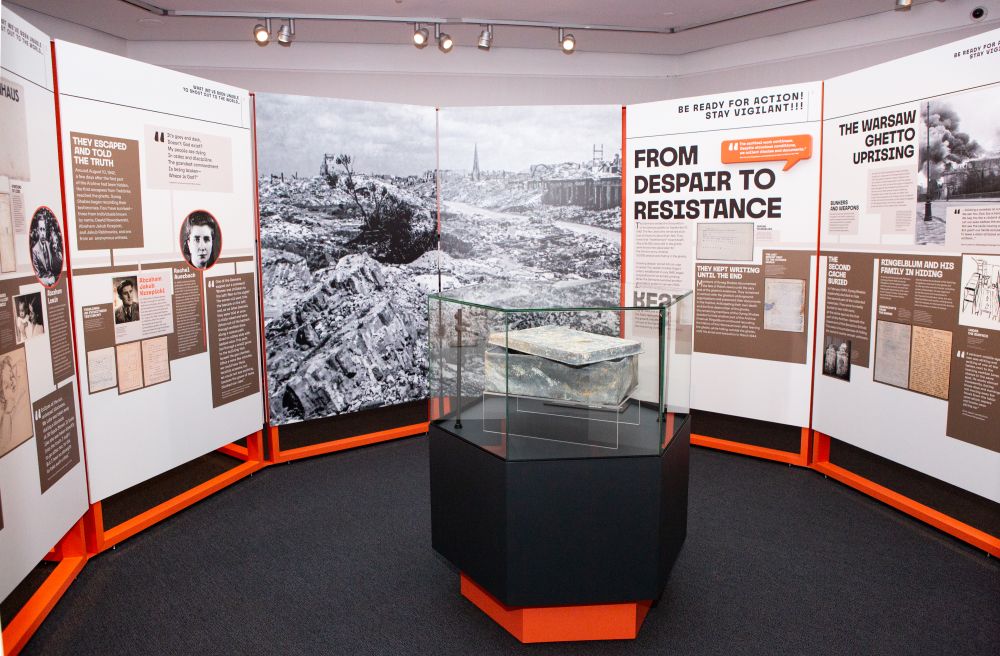
The exhibition showcases original artefacts, including one of the boxes in which the Archive was buried, as well as reproductions, maps, infographics, animations, and video recordings produced during post-war excavation works. The documents on display include a page from Ringelblum’s diary written in Yiddish or the German ordinance of July 22, 1942, on the mass deportation of Jews from Warsaw. Officially, the campaign was described as “resettlement to the East,” but in reality it entailed mass transports to the death camp in Treblinka. Another exhibit is an invitation to the Seder dinner organized in Janusz Korczak’s orphanage, dated April 1942 and addressed to Ringelblum and his wife Judyta.
The traveling exhibition titled “Will These Words Reach You? The Underground Archive of the Warsaw Ghetto” was developed by the Jewish Historical Institute in Warsaw in cooperation with the Museum of Jewish Heritage – a Living Memorial to the Holocaust, YIVO Institute for Jewish Research, and Association of the Jewish Historical Institute in Poland. The project was financed by Taube Philantrophies, Irene Kronhill Pletka, and the Kronhill Pletka Foundation, with additional support from the Ministry of Foreign Affairs and the Polish Cultural Institute New York.
The exhibition curators are Zuzanna Schnepf-Kołacz, Deputy Director for Programme at the JHI, and Marta Janczewska, Deputy Head of the Research Department at the JHI. The managing curator is Marta Sarnowska, Head of the Education Department at the JHI.
The exhibition will be on display at the Museum of Jewish Heritage – A Living Memorial to the Holocaust in New York until February 14, 2027.
Exhibition Will These Words Reach You?
The Underground Archive of the Warsaw Ghetto Museum of Jewish Heritage. A Living Memorial to the Holocaust, New York
September 18, 2026 - February 14, 2027
Authors of the exhibition concept and curators Marta Janczewska, Zuzanna Schnepf-Kołacz
Exhibition coordinator Marta Sarnowska
Local section curators Tamar Rabinowitz, Sara Softness, Eddy Portnoy
Exhibition design Anna Rzeźnik, Kasper Skirgajtto-Krajewski, Malina Rostocka, (
Exhibition production Konrad Kamać (Forma i Detale)
Exhibition management: Matthew Meade (MJH)
Maps Wawrzyniec Święcicki, Kasper Skirgajtto-Krajewski
Animation Domnika Struzik, Justyna Gawełko
Conservators Violetta Bachur (JHI), Maciej Stasiewicz (JHI), Emily Finan (MJH Registrar)
Translation Zofia Sochańska, Natalia Kłopotek, Jennifer Bell, Eleonora Bergman, Anna Brzostowska, Maria Ferenc, Jerzy Giebułtowski, Katarzyna Gucio, Raphael Halff, Krzysztof Heymer, Christopher Hutton, Dianne Levitin, Michael C. Steinlauf, Lena Watson
Proofreading Eleonora Bergman, Stuart Dowell, Tamar Rabinowitz, Zofia Sochańska, Sara Softness
Exhibition key visual: Anna Rzeźnik, Kasper Skirgajtto-Krajewski,
Catalog design Agnieszka Prus
Accompanying program: Jennifer Goldsmith, Anna Michalska, Bartosz Remisko, Julia Rothkoff, Marta Sarnowska, Sydney Yaeger
Consultants: Eleonora Bergman, Barbara Engelking, Maria Ferenc, Agnieszka Kajczyk, Samuel Kassow, Barbara Kirshenblatt-Gimblett, Justyna Majewska, Agnieszka Zółkiewska.
![Oyneg-Logos_wBG-08.24-1-scaled (1).png [20.76 KB]](https://www.jhi.pl/storage/image/core_files/2026/9/22/f16fd7f520b6efd11fb5b16323d7fc02/png/jhi/preview/Oyneg-Logos_wBG-08.24-1-scaled%20(1).png)
Photo courtesy the Museum of Jewish Heritage, Rebecca Greenfield.




![MKiDN_bialy_logotyp_strona_ŻIH_EN.png [10.32 KB]](https://www.jhi.pl/storage/image/core_files/2023/1/12/0fbb15388d1a5d89c65891b6ce66941c/png/jhi/preview/ZNAK%20ENG.png)