
- News
- Events
- Oneg Shabbat
- Collections
- Research
- Exhibitions
- Education
- Publishing Department
- Genealogy
- About the Institute
- Bookstore

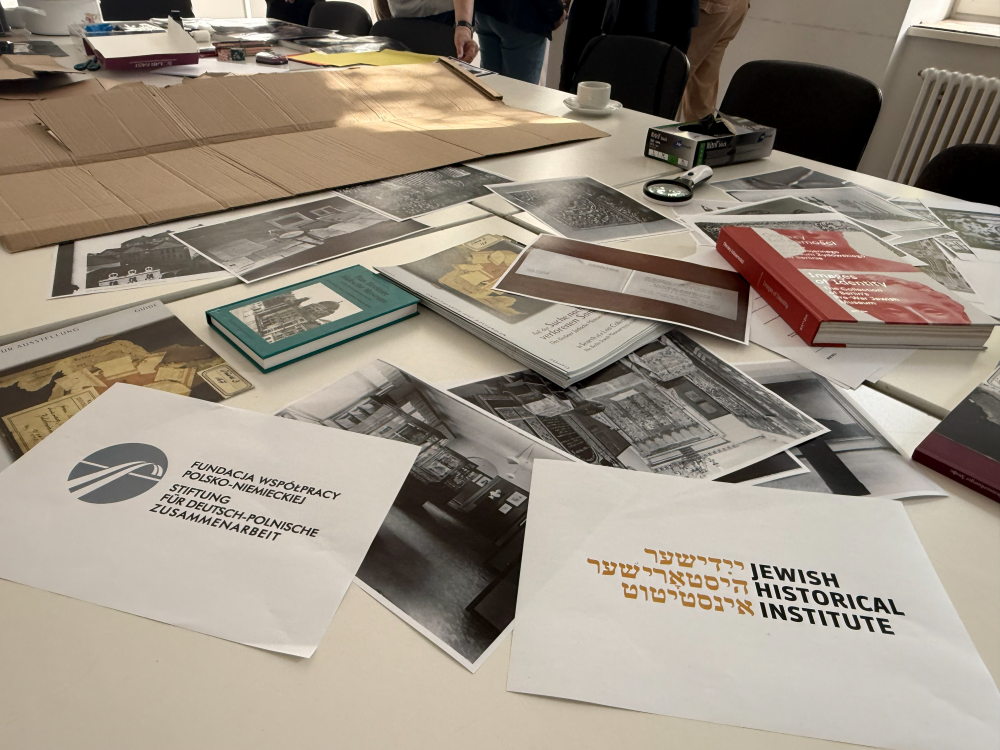
The events, held under the title Imprints of History, were organised as part of a collaboration between the Jewish Historical Institute and Stiftung Neue Synagoge Berlin – Centrum Judaicum, the institution regarded as the spiritual successor to Berlin’s pre-war Jewish Museum. It was here, on Oranienburger Straße, that the museum opened in 1933, only to have its activities brutally brought to an end by Nazi persecution. A surviving fragment of its remarkable iconographic collection, now held by the Jewish Historical Institute, became the starting point for a Polish-German dialogue on memory and responsibility for cultural heritage.
The expert workshop was preceded by a public event held on 6 September 2026 under the title Imprints of History – Insights into Two Jewish Collections. Participants had the opportunity to learn about the history of Berlin’s pre-war Jewish Museum and visit the collection storage facilities of Centrum Judaicum, which are normally closed to the public. The event explored the fate of the dispersed collection and the significance of surviving photographs and negatives as testimonies to lost heritage. The programme also included a creative workshop in which participants experimented with cyanotype and pinhole photography, producing their own visual “imprints” of objects that no longer exist. The event provided an opportunity for collective reflection on what remains of lost collections and how their histories can be brought back into public memory today.
The expert programme on 1 October was opened by Anja Siegemund, Director of Centrum Judaicum, who welcomed the participants and invited guests. Researchers and museum professionals affiliated with the Dubnow Institute in Leipzig, the Jewish Museum Berlin, Berlinmuseum, Mitte Museum, and the district museums of Spandau and Charlottenburg-Wilmersdorf were also invited to take part.
One of the highlights of the programme was a presentation by Marta Kapełuś, curator of the exhibition Images of Identity, entitled A Surviving Fragment of Berlin’s Prewar Jewish Museum: A Collection Preserved in Poland. She explored the history and significance of the Berlin museum’s iconographic archive. Following the museum’s closure in 1938, its collections were dispersed, and a substantial part of them found their way to Poland after the war. In 1951, nearly 4,000 cardboard-mounted sheets containing photographs, prints and other iconographic materials, together with more than 1,200 glass negatives, became part of the Jewish Historical Institute’s collections.
Marta Kapełuś’s research demonstrates that the archive is not merely a record of Jewish culture, art and everyday life, but also a testimony to the deliberate choices made by its creators — to what they considered worthy of preservation for future generations. Today, photographs of synagogues that no longer exist, missing works of art and lost ritual objects have acquired particular significance: in many cases, they remain the only surviving traces of heritage that has disappeared forever. The history of this collection also raises questions about the role of museums in shaping collective memory, and about how collections marked by the experience of war and the Holocaust can be interpreted and made accessible to contemporary audiences.
The expert programme also featured contributions from Dr Magdalena Wójcik of the Jewish Historical Institute, who presented materials documenting the pre-war Jewish communities of Berlin, Wrocław and other cities preserved in the Institute’s archives, and Dr Felicitas Heimann-Jelinek, an art historian and specialist in Judaica, who addressed the challenges of provenance research and the dispersal and reconstruction of historical Jewish collections.
Another important part of the event was a presentation of the results of an artistic residency involving three contemporary artists: Hadass Gilboa, Joe Turpin and Matan Tal. Working with archival and museum materials from Centrum Judaicum and the Jewish Historical Institute, the artists explored new ways of interpreting absence, loss and the fragmentary nature of historical collections. They presented concepts for workshops aimed at art students and emerging artists, in which artistic practice would serve as a means of exploring and reinterpreting cultural heritage.
The event concluded with a discussion on ways of bringing together museum research and artistic practice, the potential of digital technologies, and the development of new approaches to making collections accessible to the public. Participants also discussed prospects for further cooperation between the Jewish Historical Institute and Centrum Judaicum, including joint research and educational initiatives.
***
The events were organised as part of a collaboration between Stiftung Neue Synagoge Berlin – Centrum Judaicum and the Emanuel Ringelblum Jewish Historical Institute, with financial support from the Foundation for Polish-German Cooperation.
Project coordination on behalf of the Jewish Historical Institute:
Zuzanna Benesz-Goldfinger
Project coordination on behalf of Centrum Judaicum: Quoi Röwer, Monika Keenan


Photographs courtesy of the Centrum Judaicum


