- News
- Events
- Oneg Shabbat
- Collections
- Research
- Exhibitions
- Education
- Publishing Department
- Genealogy
- About the Institute
- Bookstore

The Warsaw Ghetto Uprising
On the eve of the Uprising, the majority of the remaining inhabitants of the Warsaw ghetto—approximately 35,000 people—were employees of the German factories working for the military (the so-called ‘shops’), or members of the employees’ families. Spared during earlier deportations, they were strictly isolated and continually deceived with the promise of survival. The shops were located in various areas within the former ghetto, not connected to one another. Both the Többens shop branch on Prosta Street (within the former “small ghetto” area) and the brushmakers’ shop employed approximately 3,000–4,000 workers each, while the main concentration of shops north of Leszno Street employed up to 20,000 people overall. Several thousand individuals lived in the blocks of apartments along Niska Street—they were employees of the Werterfassung, the enterprise managed by Franz Konrad and responsible for clearing the ghetto, and their families.
Distrustful of the occupying force, both the employees of the shops and the remaining residents in most cases chose what they saw as the only viable solution—hiding within the ghetto area itself, since staying on the ‘Aryan’ side was extremely costly and highly dangerous. From the autumn of 1942 onwards, people had been organising hiding places in the attics and cellars, hoping to survive liquidation actions launched by the Germans by hiding there. One reason for the accelerated construction of such hideouts was a noticeable escalation of terror. Even the best certificates no longer offered protection against being shot dead in the street. In his report on the liquidation of the ghetto, Jürgen Stroop, the commander of the German police and SS, recorded that by 16 May his units had detected and destroyed a total of 631 bunkers and other shelters in which Jews were hiding. The captured Jews were taken to the Umschlagplatz or killed on the spot. In this way, 15,000 people were killed, and more than 35,000 were sent to labour camps in the Lublin district (Stroop 2009).
The exceptional nature of the four-day armed resistance inside the ghetto lies not in the military dimension of the clash—many such confrontations occurred during the Second World War—but in the unprecedented fate of the thousands of victims, who were being mercilessly murdered and burned alive.
There exists a body of memoir literature on the Warsaw Ghetto Uprising, albeit highly fragmentary. Some accounts were written immediately after the War, others many decades later, often displaying a clear tendency towards the heroization of events and the emphasis on the authors’ own roles within the veterans’ movement. Moreover, these testimonies come exclusively from the members of a single organisation, the Jewish Combat Organisation (Żydowska Organizacja Bojowa, ŻOB), as none of the fighters from the other group, the Jewish Military Union (Żydowski Związek Wojskowy, ŻZW), survived the war. There is also a considerable number of confabulations, including texts whose authors falsely claim affiliation with Polish units allegedly fighting shoulder to shoulder with the ghetto fighters. The confrontation of these two types of sources—Jewish memoirs and the Stroop Report—does not allow for a fully objective reconstruction of the course of events.
The revolt
On 19 April 1943, on the eve of the festival of Passover, German forces numbering approximately 850 soldiers entered the ghetto once again, but this time they encountered armed resistance. In theory, the German plan was highly elaborate—the main shops (Többens’ tailoring and fur shops, Schultz’ shops, and the brushmakers’ shop working for the Wehrmacht, the Heeresunterkunftsverwaltung) were to be transferred to the Lublin district, to Poniatowa and Trawniki, where appropriate facilities had already been established several months earlier. Physical annihilation at Treblinka was to apply only to the so-called ‘wild’ Jews who, according to the Germans, resided in the ghetto illegally. Despite these assurances, no one believed that the occupying force would keep their word.
The two Jewish fighting organisations took up positions along the main arteries of the ghetto—Nalewki, Zamenhofa, and Leszno Streets—as well as at two insurgent strongholds—Muranowski Square (where the units of the Jewish Military Union were stationed) and the brushmakers’ shop at the intersection of Świętojerska and Wałowa Streets (where the Bund groups were ready for action). The civilian population had been hiding in bunkers since the previous evening. The worst-case scenario turned out to be true, which did not come as a surprise to anyone—the day before, on 18 April, rumours of a possible action had begun to circulate in the ghetto. Something was happening in the Judenrat building on Zamenhofa Street (most of its members were arrested and taken as hostages), and during the night members of the underground resistance issued a warning that new Ukrainian forces had been surrounding the ghetto.
On the morning of 19 April, a German column commanded by Ferdinand von Sammern-Frankenegg entered the ghetto from the side of Nalewki Street. The Germans were heavily armed, yet nothing suggested that they had anticipated any significant Jewish resistance. The German units were preceded by a group of Jewish policemen, used as the so-called human shields (AZŻIH, 302/129; 302/188). At the same time, however, another high-ranking SS officer, SS-Brigadeführer Jürgen Stroop, had been present in Warsaw for two days, so Sammern must have assumed that in the event of failure Stroop would take over the command. At this point, the Germans had at their disposal far greater military resources than during the Great Deportation Action the previous year. No more than about one hundred SS men had taken part in the Aktion back then; now, there were more than one thousand personnel from two SS training battalions (grenadiers and cavalry), approximately 300 German policemen and a similar number of Polish policemen, as well as a battalion of guards from the camp in Trawniki. Their armament was substantial, reinforced by an assigned anti-aircraft artillery battery, one tank, and two armoured cars. Historical documentation of the first day of fighting is, unfortunately, very fragmentary. It appears, however, that German units entered the ghetto from the direction of Nalewki Street and from Gęsia Street, near the building at 33 Nalewki Street. The column—possibly formed by the merging of two units—came under fire from hand-held weapons and was attacked with grenades and bottles filled with gasoline. These attacks were carried out by the groups led by Zachariasz Artsztajn from Dror and by Paweł Bruskin, commander of a communist unit.
An unnamed member of the Jewish Combat Organisation AZŻIH, 230/121) recalled shortly after the War: “At 5:35AM, when the first compact SS column marched into the ghetto via Nalewki Street, it was attacked from the front of the building at number 33 with bombs, grenades [the following page is poorly legible – A.Ż.], and incendiary bottles. Several rifle shots were fired. The Germans quickly removed their wounded [and] their dead and withdrew from the ghetto. A rifleman from this building fired several shots at the Nalewki–Świętojerska guard post— two accurate hits were noted. This column evidently intended to secure Miła Street, which the Germans had long regarded as the centre of the underground operation. At around 7AM, another SS column was once again broken up in the same manner and in this same location. In order to secure a retreat route, we set fire, using several bottles, to the corner building at 24 Gęsia Street / 37 Nalewki Street, which was filled with highly flammable materials…”.
The Germans were indeed taken by surprise, so much so that Sammern ordered a withdrawal from the ghetto. The evacuation most likely followed a different route—along Gęsia Street toward Zamenhofa and Stawki Streets (Sammern’s unit reportedly stopped at the square in front of the Judenrat building on Zamenhofa Street)—and during this manoeuvre the German units were again attacked at the corner of Zamenhofa and Miła Streets. Mordechai Anielewicz, commander of the Jewish Combat Organisation (ŻOB), is said to have taken part in the fighting that morning. ŻOB combat groups were commanded by Berl Broide, Leyb Gruzalc and Merdek Growas. The attack must have made a strong impression on the Germans, as Sammern decided to deploy the only tank at his disposal (a light tank manufactured in Czechoslovakia). The fighters set it on fire using bottles filled with gasoline, wounding members of its crew. Another anonymous witness recalled this moment with evident euphoria:
“They advanced cheerfully, carefree, searching for Jewish women, old people, men and children. Suddenly, incendiary grenades were thrown from the windows of the buildings at the corner of Zamenhofa and Miła Streets. These ‘heroes,’ accustomed to slaughtering the defenceless, fled in panic, seeking shelter in gateways […] An hour later, the Gestapo brought tanks of various types into the ghetto and, under their cover, launched another attack. None of them, however, was able to enter a single building on Miła Street, as each building was a fortress.” (AZŻIH, 301/471)
Stroop took over the command from the hands of the shaken Sammern, and after two hours the Germans were once again inside the ghetto—both on Nalewki Street (after several hours of combat, the fighters hid in a bunker at 37 Nalewki Street) and along the second main artery, Zamenhofa Street. The main clash—a fierce exchange of fire—took place at the corner of Miła Street, slightly more to the north. The Main Command of the Jewish Combat Organisation (ŻOB) in the central ghetto was located under the building at 29 Miła Street. It was fiercely defended up until 24 April. After its destruction—the Stroop Album contains several photographs documenting the attack on this building—the headquarters moved to 9 Miła Street and subsequently to 18 Miła Street. It appears that, owing to the strong resistance—the insurgents defended themselves using grenades and bottles filled with flammable liquid—and the fact that the Germans didn’t know the area well enough, the German attack was not very intense. Only shortly before 6PM did the German forces break through Nalewki Street towards Muranowski Square where they encountered strong resistance from a well-armed Jewish Military Union (ŻZW) unit. Access to the Square was defended by the one and only machine gun that the insurgents possessed. That day, twenty-three German soldiers were wounded, including fifteen SS men. The ŻZW suffered more serious losses—among the dead was Deputy Commander Eliahu Halberstein. Nevertheless, two flags—a Polish one and a Jewish one—were successfully planted on the roof of a building at the corner of 42 Nalewki Street and 21 Muranowska Street. In the evening, after the retreating fighters set fire to a mattress warehouse at the corner of Nalewki and Franciszkańska Streets, the German units withdrew beyond the ghetto (AZŻIH, 301/1750).
In a communiqué issued on 23 April by the ‘Żegota’ Council to Aid Jews (AZŻIH, 230/141; 230/142) it was reported that on the first day of fighting—while the attack on the building at the corner of Miła and Zamenhofa Streets was still ongoing—“tables were set up on Nalewki Street near Muranowski Square, with huge maps, charts, and field telephones on them. A number of high-ranking SS officers were debating under the protection of stationed tanks and armoured cars.” The aforementioned Stroop’s mobile headquarters were installed in front of the Judenrat building at the corner of Zamenhofa and Gęsia Streets.
Fighting on that day did not spread to the area of Niska Street or the western section of Miła Street, where employees of the Werterfassung resided. According to Stroop, the highest number of casualties that day—580 arrested and 380 shot on the spot—came from the central ghetto (west of Nalewki Street). They were people caught by surprise in the streets and thus deprived of a chance to hide in shelters.
Work continued as normal in the shops. Only in the brushmakers’ shop took a break that lasted several hours. None of the fighters operating in that area attacked the factory guards.
In the autumn of 1943, Pinia Besztymt (‘Rudy Paweł’, or ‘Red-haired Paul’), one of the soldiers of the Jewish Military Union (ŻZW) who was then in hiding on the ‘Aryan’ side, recalled the first day of the Uprising: “It lasted from 6AM [on 19 April – A.Z.]—that is when the first clash occurred. At 29 Miła Street, several grenades were thrown, and the first Germans fell. According to our estimates, there were several dozen casualties on the German side. The Germans set the building on fire, and our boys withdrew. The fire brigade extinguished the blaze, though they seemed more interested in the mobile property than in putting out the fire. After a short break, around 10AM, there was another skirmish on Miła Street, and more corpses in several buildings (we could not count them, but there were many). Later, more fighting took place at 7 Miła Street and at 42 Nalewki Street—here we raised the Polish and Jewish flags, made from a blanket and a broom. Many SS-men were killed there, too. Then, back to 39 Nalewki Street. We set fire to the Brauer shop. At 11–13–15 Muranowski Square we fired from the windows; the deputy commander of our unit was killed. Large tanks entered. Mad fire from heavy machine guns and cannons began. We abandoned the area. […] The centre of the fighting shifted to the brushmakers’ shop. […] On 22 April, we withdrew to the ‘Aryan’ side following the orders of the officer cadet who had been with us the entire time.” (AGFH, 5970)
The second day of the Uprising began with clashes on Muranowski Square. Stroop ordered the removal of the flags flying above the ghetto and the seizure of the entire Square. German forces blew up nine bunkers, but most residents had managed to escape beforehand through underground passages to other hiding places. It was not possible, however, to evacuate patients from the Jewish Hospital in Czyste. The entire area was cut off from the electricity supply.
In the early afternoon, a mine was detonated at a gate leading to the brushmakers’ shop in response to a German call for the workers to report voluntarily to the Umschlagplatz, from where they were to be transported to the labour camp in Poniatowa. In response to Többens’s appeal, only twenty-eight people reported for departure that day. In retaliation, Stroop ordered setting up the entire city block on fire. Artillery was deployed (two artillerymen were killed), with no regard for the losses in equipment and raw materials. Most of the fighters, commanded by Marek Edelman, broke through to the central ghetto. At that point, the fighters’ headquarters moved to a bunker at 30 Franciszkańska Street. Engineer Michał Klepfisz was killed in combat; a month later he was posthumously awarded the Virtuti Militari Cross by General Władysław Sikorski. One of his comrades recalled: “They cut off our route from 6 Wałowa Street. I fired twice from my rifle. I killed one man; the second German kept shooting at us with his pistol. Of the four comrades who had jumped into position with me, one was killed (M.K., an engineer from the Warsaw Polytechnic—our pyrotechnician, the maker of bombs, grenades and bottles). He stepped carelessly into the line of fire. I myself was lightly wounded in the face, probably by a fragment of sheet metal from the roof…” (AZŻIH, 230/121)
In the afternoon, a column of German units marching along Leszno Street, alongside the Többens’ shop, was attacked with grenades and gasoline-filled bottles by a Jewish Combat Organisation unit commanded by Eliezer Geller. Once again, a German tank was set on fire. In the evening, the first anti-German diversion was carried out by the Polish underground. On Bonifraterska Street (between Świętojerska and Franciszkańska Streets), a sabotage unit commanded by Captain Józef Pszenny attempted to blow up the ghetto wall in order to enable the insurgents to escape. Alas, the bomb exploded in the middle of the roadway, the wall remained intact and several Polish fighters were killed in the process. One Polish Blue Policeman was also killed, and two Germans were wounded.
On Tuesday, the third day of the Uprising, fighting continued throughout the day over the insurgent redoubt at Muranowski Square. Although the Germans succeeded in tearing down the flags planted on the rooftop, SS Lieutenant Dehmke was wounded during the attack and died the following day.
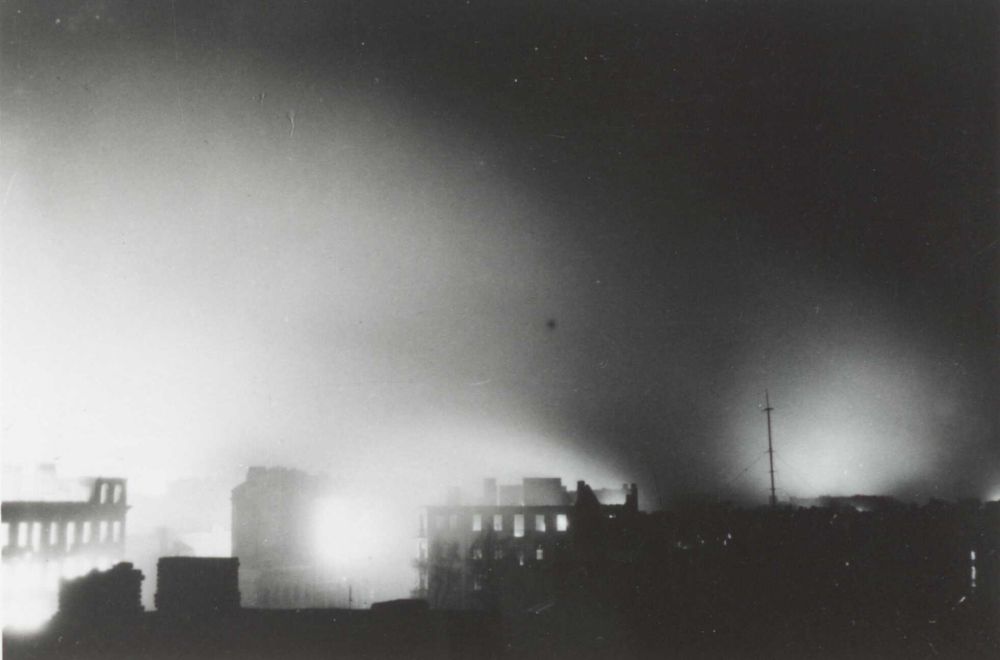
The following day, on 22 April, Stroop began to systematically set the ghetto on fire, street by street, in order to force the Jews hiding in the bunkers to emerge. In his report, he recorded the next day: “On 23 April 1943, the Reichsführer-SS, via the Higher SS and the East Police Commander in Kraków, issued the order to search the Warsaw ghetto with the utmost ruthlessness and relentless severity. I therefore decided to proceed with the complete destruction of the Jewish residential district by burning down all residential blocks, including those adjacent to armaments factories.” (Stroop 2009, p. 38)
To his surprise, it turned out that there existed an extensive system of underground hideouts, well equipped and connected by sewer channels not only within the ghetto but also on the ‘Aryan’ side. In the area of the brushmakers’ shop alone, there were more than a dozen such shelters. Most of them were discovered and destroyed by the Germans during the first week of the Uprising.
The Germans aimed at transferring the shops, their equipment and their work force to labour camps in Poniatowa and Trawniki. Stroop had to take this objective into account, too. By mid-March, the owners of the two largest shops, Walter Caspar Többens and Fritz Emil Schultz, had managed to send only about one thousand people to the Lublin district. The remainder failed to respond to the summons. However, since the pressure from the SS was indeed very strong, Többens—meanwhile appointed plenipotentiary for resettlement affairs—decided to organise a meeting of more than one hundred Jewish managers from all the ghetto shops. During the meeting, held on 26 March, he assured them that voluntary departure was the only way to avoid deportation to Treblinka. This applied to approximately 30,000 people—employees of the German shops and their families. By 19 April, Többens and Schultz had succeeded in persuading or coercing another thousand people to depart. On the evening of 20 April, Stroop ordered Többens to organise an evacuation of workers from all the shops in the area between Leszno and Nowolipki Streets the following day at 6AM. It is not entirely clear, alas, whether this order also applied to the brushmakers’ shop. Approximately 5,000 workers responded (including 1,423 from Schultz’s shop, according to the entries in his diary; Grabitz, Scheffler 1988), out of an estimated total of 20,000 employed.
The mass expulsion of the ghetto inhabitants began as early as 22 April. On that day, in his report, Stroop recorded a deportation of 1,100 people to the Umschlagplatz. The following day, the number rose to 3,500. Many Jews did not believe that the Germans intended to transfer them to the Lublin district and therefore remained in hiding. This compelled Stroop to announce further so-called amnesties or “last chances” on 24 and 28 April. Reactions among those in hiding varied—the majority ultimately emerged from their shelters, while others feared that potential informers might be present among them who could betray the locations of bunkers. Ultimately, 12,000 of the approximately 30,000 Jewish workers employed in all ghetto shops voluntarily left their hiding places.
These above-mentioned ‘amnesties’ were a form of deception—Stroop’s primary objective was the elimination of armed resistance. This is confirmed by an entry in his report from 24 April: “In this labyrinth of buildings there was an armaments enterprise of sorts [a block of buildings of the so-called Werterfassung on Niska and Pokorna Streets], which allegedly possessed materials belonging to the Wehrmacht, worth many millions, both for processing and in storage. On 23 April 1943, at approximately 9AM, I informed Wehrmacht of my intention, demanding the removal of the materials […]. At 6:15PM, a search combat unit entered the buildings after they had been sealed off and discovered a high number of Jews present there. Since some of those Jews put up resistance, I ordered the buildings to be set on fire. Only when the street and all courtyards on both sides were in flames did the Jews emerge from the block of buildings. Some had already caught fire. Others attempted to save themselves by jumping from windows and balconies into the street, onto which they had previously thrown duvets, eiderdowns, and other objects. It became obvious that, despite the raging fire, Jews and bandits preferred to return into the flames rather than end up in our hands.” (Stroop 2009, p. 58)
Stroop’s report from 3 May was written in a similar tone: “In most cases, Jews put up armed resistance before leaving the bunkers. As a result, two instances of injury have been recorded. Some Jews and bandits fired pistols with both hands. In view of the fact that, as was established today, many Jewish women had pistols concealed under their skirts, from today on, all Jews and bandits are required to strip during searches.” (Stroop 2009, p. 78)
The peak of the fighting
From the very first day, the Germans’ primary goal was to destroy the Jewish forces fighting on Muranowski Square. It should also be noted that the Germans were not aware of the internal divisions within the Jewish underground. Stroop was particularly irritated by the Polish and Jewish flags hoisted on top of the building. On 20 April, the German forces attacked the insurgents’ positions at the Square, most likely from the direction of Muranowska and Gęsia Streets. By the end of the day, the Germans had liquidated nine bunkers. Only sixty civilians surrendered; others moved on to different hiding places. It was most likely on that day that the Germans set fire to the corner buildings at the Square. Patients and some of the medical staff from the Jewish Hospital in Czyste, which at that time was housed in a corner building on Nalewki Street, were also murdered. On that day, electricity in the central ghetto was cut off as well. The water supply continued to be connected for some time longer.
On the third and fourth days of the Uprising—21 and 22 April—only Muranowski Square continued to put up significant resistance to the Germans. On the night of 22 April, most of the Jewish Military Union (ŻZW) forces withdrew through a tunnel to 6 Muranowska Street. After several days, they were evacuated to Michalin. Those members of the Union under the command of Paweł Frenkel who continued to use the tunnel in the days that followed hid in the attic of the aforementioned building at 6 Muranowska Street (Polish civilian population had been long gone by then). Most likely on 27 April they were discovered by the Germans. Despite putting up armed resistance—the Stroop report mentions 120 individuals (twenty-four soldiers killed, fifty-two captured)—most fighters were killed by the SS units commanded by Police Lieutenant Diehl. The remaining survivors, including Frenkel, returned to Warsaw several weeks later. The Germans discovered their hiding place at 11 Grzybowska Street and, after a fierce clash, destroyed it in early June.
On the final day of the Uprising proper, namely on 22 April and over the course of the following two days, clashes of varying intensity occurred throughout the entire ghetto, including the main shop area between Leszno and Nowolipie Streets as well as the brushmakers’ shop. This was already after the large-scale deportation of workers from that area the previous day. The fighters, almost completely unarmed, usually waited until a column of prisoners had passed and only then attacked the guards. Szymon Heller of the Hashomer Hatsair group (he would perish on 26 April) was the only one to possess a rifle. In the shops area, combat groups commanded by Eliezer Geller were led by Yakov Fajgenblat, David Nowodworski, Shlomo Winogron and Izrael Wolf Rozowski. This was already the beginning of a phase of guerrilla warfare—the fighters fired at the Germans only when they entered courtyards, set buildings on fire or searched for bunkers. Thousands of people perished in the flames. The last fighters from this area hid in a bunker at 56 Leszno Street and, several days later—on 29 April, withdrew through a tunnel to the ‘Aryan’ side, to a hiding place at 27 Ogrodowa Street, from where they were transported to Łomianki.
Stroop commented on burning down the shop area in his report from 4 May: “At approximately 11AM, the main forces were deployed with the goal of searching, clearing, and destroying two large blocks of buildings formerly belonging to the firms Többens, Schulz & Co., and others. After these blocks had been tightly surrounded, the Jews who were still staying there were first called upon to surrender voluntarily. 456 Jews were apprehended that way and sent for transport to camps. Only when fire began to destroy the buildings did a higher number of Jews emerge, driven out by the flames and smoke. In many cases, Jews continued to attempt to force their way even through burning buildings. An indeterminate number of Jews who appeared on rooftops while the fire was raging perished in flames. Others appeared on the highest floors at the last moment and could save themselves from death in flames only by jumping down.” (Stroop 2009, p. 80).
The final clashes
On 24 April, Germans discovered the main bunker of the Jewish Combat Organisation (ŻOB) at 29 Miła Street. Under the cover of the night, while returning fire, some of the fighters—together with a group of civilians—moved to 9 Miła Street and later to the bunker of the Organisation’s high command at 18 Miła Street. Shmul Aszer, one of the best-known smugglers in the ghetto, was a civilian commander of the bunker network.
On the fourth day of the Uprising, Mordechai Anielewicz sent a letter to Yitzhak Cukierman, the ŻOB representative on the ‘Aryan’ side. He wrote: “23 April 1943. Cheerio, Yitzhak […] There is only one phrase which can describe my feelings about our comrades. Something has happened that has exceeded our boldest expectations—Germans fled the ghetto twice. One of our units held out in combat for forty minutes, and another one for more than six hours. A mine planted in the brushmakers’ shop’s area exploded. So far, we have lost only one man: Yechiel. […] I cannot even begin to describe to you the conditions in which the Jews are living. Only few will endure. All the rest will perish, sooner or later. Their fate is sealed. It is impossible to light a candle at night in the bunkers where our comrades are hiding. There is not enough air for that.” (AAN, 202/XV, vol. 2, fol. 114)
The Bund members under the command of Marek Edelman were hiding separately, in a bunker at 30 Franciszkańska Street, which explains why Anielewicz was unaware of the death of Michał Klepfisz. On 27 April, the Bundists were joined by the remnants of Leyb Gruzalec’s group, which had been discovered at 29 Miła Street (they left that shelter in protest after their seriously wounded comrade, Meyloch Perelman, was refused admission to the bunker at 18 Miła Street). On 1 May, the Bundists fought a battle in defence of the shelter on Franciszkańska Street which had been doomed from the very start. Those who survived moved to the last remaining bunker at 22 Franciszkańska Street.
The situation was becoming hopeless as the Germans destroyed one shelter after another. The fighters therefore began to consider escaping from the burning ghetto. The only possible route of escape was through the sewer system, despite the fact that, from the very first day of the Uprising, the Germans had been blowing up sewer outlets, flooding them with water, and regularly throwing in gas from kerosene candles. We do know from the testimonies of the few who had survived that there were cases of successful escapes. Assistance from Polish sewer workers and smugglers who cooperated with them was essential. Such help was costly, amounting to at least one thousand zlotys per person. Three reconnaissance groups were sent out on 7 May. On 9 May, Szymon “Kazik” Ratajzer (Symcha Rotem) was the only one to return to the ghetto. He encountered a group of fighters in a sewer where he had descended after several hours of searching through the ruins near the bunker of the high command. After a few hours, a group of approximately forty fighters capable of passing through the sewers was assembled. Most of them emerged on the ‘Aryan’ side through a manhole on Prosta Street on the morning of 10 May. They were transported to Łomianki in a truck organised by Władysław Gajek (“Krzaczek”), member of the Polish Workers’ Party (PPR).
As we know from Stroop’s report, on 7 May the Germans found out about the bunker at 18 Miła Street from a Jewish informer. On the following day, poisonous gas was pumped underground. Two hundred fighters perished, the majority of them (140 individuals according to Stroop) by suicide. Four SS men were killed in combat; the enemy confiscated twenty pistols, some ammunition and grenades. Only a handful of fighters from the Jewish Combat Organisation survived; a unit led by Edelman managed to locate them at night. Contrary to a widespread belief, the call for suicide was issued by Arie Wilner, not by Commander Anielewicz. Alas, we do not know whether the civilians hiding there surrendered or were killed on the spot.
The last significant clashes took place on 10 and 13 May. During the defence of the bunker at 3/5 Bonifraterska Street, three SS men were killed and four were wounded. In all likelihood, groups led by Zachariasz Artsztajn (Dror) and Shmuel Łopata (ŻZW) who had remained in the ghetto participated in these clashes. Stroop’s report from 13 May most likely refers to that: “It has transpired today that the apprehended Jews and bandits belong to the so-called combat groups. They are mostly young men and women aged 18–25. A regular skirmish broke out during the liquidation of one of the bunkers. Jews not only fired model 08 pistols and Polish Vis pistols, but also hurled Polish egg-shaped hand grenades at soldiers of the SS military formations. After part of the bunker’s crew had been apprehended and was about to be searched, one of the women, as had often occurred before, swiftly reached beneath her skirt, pulled a hand grenade, unlocked it and threw it at the feet of the soldiers who were about to search her, while she herself instantly jumped aside to a safe place.” (Stroop 2009, p. 97)
The evacuation and burning of the so-called small Többens shop on Prosta Street between 12 and 16 May appear to have taken place without putting up armed resistance by its employees, which is to some extent puzzling, given that—according to Stroop—234 Jews were arrested at that time and 155 were killed on the spot.
During the first four days of the Uprising, death toll among the occupying force amounted to seven people. In total, sixteen of Stroop’s subordinates perished, including two Ukrainian guards from the Trawniki camp and one Polish policeman (murdered outside the ghetto during a Polish armed operation on Bonifraterska Street).
One of the fatalities was an officer—SS-Untersturmführer Otto Dehmke—who died of wounds sustained during the attack on the Jewish Military Union positions at Muranowski Square. On the second day of the Uprising, two artillerymen were also killed. Overall, up until 16 May, eighty-five individuals were wounded, including nine Ukrainians and six Poles. Of the two SS units deployed—the 3rd Grenadier Battalion and the Cavalry Training Battalion (821 soldiers and nine officers)—twenty-seven of the wounded were cavalrymen and twenty-one were grenadiers. The rest belonged to the Order Police (Orpo; 1st and 3rd Battalions), the Security Police (Sipo, Gestapo), or a small artillery formation. The highest number, i.e. 24 individuals were wounded on the first day of the Uprising. In the following days, losses were significantly lower; on 20 April, nine Germans were wounded by the ghetto fighters.
To sum up, for at least four days between one and two thousand well-armed Germans fought against approximately eight hundred insurgents in the ghetto. Two hundred and fifty members of the Jewish Combat Organisation (ŻOB)—organised into seventeen units (five in the central ghetto, five in the brushmakers’ shop, and seven in the shops area)—were armed only with pistols, with each fighter possessing no more than a dozen or so rounds of ammunition, as well as incendiary bottles. Collectively, they owned only three rifles, and yet they did manage to put up strong resistance to the German forces for two days (at the intersections of Zamenhofa and Miła Streets, Nalewki and Gęsia Streets, and in the brushmakers’ shop).
The number of the Jewish Combat Organisation fighters remains a matter of unresolved debate in the scholarly literature. In the summer of 1943, while in hiding on the ‘Aryan’ side in the premises at 3 Komitetowa Street, at the home of Stasia Kopikowa, Tsivia Lubetkin and Marek Edelman compiled from memory a list of fighters they were able to recall. They counted 220 names. Józef Sack (Sak) passed this list to Ignacy Samsonowicz from the Jewish National Committee, and in November Leon Feiner sent it to London via the Government Delegation for Poland. In fact, the list contains 222 names, with annotations indicating affiliation with Dror, the Bund, or Hashomer Hatsair. At least twelve names on the list belong to individuals who did not fight in the Uprising (primarily the Jewish Combat Organisation members from Kraków). In 1946, the list was published in Yiddish, together with biographical notes on the fighters, by Melech Neustadt in the book Khurban be-geto varsha [The Holocaust in the Warsaw Ghetto]. In 2014, the list was expanded and published by Anka Grupińska in Odczytanie listy. Opowieści o warszawskich powstańcach Żydowskiej Organizacji Bojowej (Reading the List: Stories of the Warsaw Fighters of the Jewish Combat Organization). Grupińska identified a total of 275 ŻOB fighters who took part in the April Uprising. Thirty-one individuals from this group survived the war.
The fighters from the Jewish Military Union (ŻZW), estimated at approximately two hundred and fifty individuals as well, were much better armed. They possessed at least one machine gun, several automatic weapons, and probably several to a dozen rifles. They effectively defended their positions at Muranowski Square for almost four days, until their withdrawal through the sewers to the ‘Aryan’ side on the night of 22 April. Armed civilians also took part in the combat during the first days of the Uprising—their number is estimated at around three hundred. Unfortunately, we know virtually nothing about how they used their personal weapons.
Limiting the assessment of the military dimension of the Uprising to four days has its shortcomings. We do know that fighting in defence of shelters continued in the later period as well—the previously mentioned two-day defence of the Jewish Combat Organisation shelter at 30 Franciszkańska Street on 30 April and 1 May being of particular importance. We know from the memoirs of Leon Najberg that a small armed group fought in the ruins of the brushmakers’ shop throughout the entire month of June.
A separate issue concerns the fate of the civilian population who hid in the ruins of the ghetto at the turn of April and May. At that point, there were no fewer than 15,000 civilians. By 1 May, Stroop recorded that more than 38,000 people had been apprehended (most of them were deported to the Lublin district), while several thousand were murdered on the spot or died in flames in their hideouts.
On 24 May, Stroop sent his summary report to Kraków. He concluded that 56,065 Jews had been apprehended, of whom approximately 7,000 were killed, 6,929 were sent to their deaths in Treblinka, and about 6,000 perished in burning buildings. A total of 631 bunkers were liquidated; nine rifles, fifty-nine pistols, and several hundred grenades were seized. Stroop also listed 108 horses and an unspecified number of helmets, uniform jackets and old trousers. Approximately ten million zlotys, nearly 10,000 U.S. dollars in gold, and an unspecified quantity of valuables were confiscated from those who had been detained. The entire ghetto, with the exception of eight buildings, was razed to the ground.
Bibliography
Stroop, Jürgen, 2009, The Jewish Residential District in Warsaw No Longer Exists!, ed. Andrzej Żbikowski, [trans. Barbara Wysocka], Warsaw: Institute of National Remembrance, Jewish Historical Institute.
This article is taken from the book “Encyclopedia of the Warsaw Ghetto: Selected Entries,” edited by Maria Ferenc, published by the Jewish Historical Institute. The publication is available on our publisher’s website. We encourage you to read it!
Photo: Franciszek Przymusiński [?], The ghetto aflame during the Uprising, April-May 1943, DZIH F 3176
The Encyclopedia of the Warsaw Ghetto and Its International Dimension under the EHRI-PL Project
Thanks to the involvement of European Holocaust Research Infrastructure Poland, the “Encyclopedia of the Warsaw Ghetto” is undergoing a process of internationalization - through the translation of entries into English, its resources are being integrated into the global scholarly discourse and the accessibility of Polish Holocaust research for the international academic community is significantly enhanced.
The Jewish Historical Institute carried out the “Encyclopedia of the Warsaw Ghetto” research project in the years 2018–2024 as part of the National Humanities Development Program. The project produced a unique compendium of knowledge on the Warsaw ghetto, the largest ghetto set up by the Germans in occupied Europe. In its digital version, the Encyclopedia comprises over 2,000 entries on individuals, institutions, events, and various aspects of life in the Warsaw ghetto, painting a multidimensional picture of its history, space, and residents.
![EHRI_Poland_aktualne_2026.jpg [43.80 KB]](https://www.jhi.pl/storage/image/core_files/2026/4/20/2f25c56d256a981d6e09818cb79833d0/jpg/jhi/preview/EHRI_Poland_aktualne_2026.jpg)
![MKiDN_bialy_logotyp_strona_ŻIH_EN.png [10.32 KB]](https://www.jhi.pl/storage/image/core_files/2023/1/12/0fbb15388d1a5d89c65891b6ce66941c/png/jhi/preview/ZNAK%20ENG.png)