- News
- Events
- Oneg Shabbat
- Collections
- Research
- Exhibitions
- Education
- Publishing Department
- Genealogy
- About the Institute
- Bookstore

.jpg)
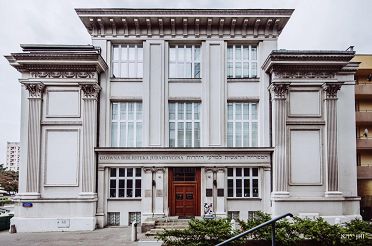
The Jewish Museum in Berlin only existed for five years, but it managed to assemble an impressive collection of sculptures, paintings, prints, and Judaica. After the November Pogrom in Germany, also known as the Kristallnacht, the authorities dissolved the museum, and the items from its collection became scattered around the world or were irretrievably lost. What survived was a so-called iconographic archive – over four thousand cardstock boards holding photos, engravings, and drawings documenting the wealth of pre-war Jewish art and culture. After the Second World War, the collection was discovered in a post-German warehouse in Lower Silesia. Following the expropriation of former German property, the State Treasury of Poland handed over the archive to the Jewish Historical Institute in Warsaw, where it has remained until today.
Held seventy-five years after the collection arrived in the Jewish Historical Institute, the exhibition Imagery of Identity. The Collection of Pre-war Jewish Museum in Berlin will be the first showcase of the iconographic archive. The exhibition seeks to revive the memory of an institution whose work was brought to an abrupt close and of the project documenting Jewish culture in which it had engaged on the eve of its dissolution. It investigates the importance of images – photos, engravings, and reproductions – for growing and passing down knowledge of the history and identity of the Jewish community.
The exhibition’s storyline begins with how the Jewish Museum in Berlin came to be, who its creators were, and in what social and political context it operated. The Museum opened on 24 January 1933 – a mere a week before the Nazi Party came to power – as a space for displaying Jewish art and cultural heritage in Germany. The narrative then takes us to the times of war: the exhibition’s evacuation to Lower Silesia by the Reich Security Main Office, its post-war discovery by the Poles, and its eventual arrival in the Jewish Historical Institute in Warsaw.
The main part of the exhibition presents the iconographic archive as a useful tool for systematising knowledge on Jewish history and culture. By juxtaposing images, figures, and events, we can build a unique visual narrative of the Jewish community. The materials in the archive cover a vast stretch of Jewish history, from antiquity to the 1930s. The chief idea of its creators was to assemble a visual compendium on the history and culture of Jews, as well as on their contributions to the development of European – particularly German – culture. Each board can be considered a visual testimony to the pre-war life of the Jewish community before the Holocaust.
What makes the archive unique is the breadth and diversity of the collected materials. The boards hold photos of artworks, reproductions of engravings and drawings, but also press clippings, invitations, or materials sent to the Museum by individuals or institutions. Some document the operation of the Museum itself, other come from various distinct contexts and places. The assembled archive paints a nuanced picture of Jewish history and culture. It also provides us with unique images of art pieces and sites which do not exist anymore.
The exhibition presents original boards forming part of the iconographic archive, negatives and diapositives, as well as documents related to the operation of the Jewish Museum in Berlin. These are accompanied by selected artworks linked with the history of the institution and by archival materials documenting the story of the collection after the Museum’s closure in 1938.
The exhibition is also accompanied by:
The exhibition Images of Identity allows us to view pre-war Jewish culture not only as a lost heritage, but also as an important part of history that continues to shape our understanding of the past.
Exhibition curator: Marta Kapełuś
Exhibition design: Aneta Faner
Film: Yael Vishnizki Levi
***
The tickets for the exhibition are available at the Visitor Service Department of our Institution and under the following link.
***
![Zrzut ekranu 2026-03-31 124506.png [148.11 KB]](https://www.jhi.pl/storage/image/core_files/2026/3/31/bc1d0fce0f027c830884f46c9a9670e4/png/jhi/preview/Zrzut%20ekranu%202026-03-31%20124506.png)
![MKiDN_bialy_logotyp_strona_ŻIH_EN.png [10.32 KB]](https://www.jhi.pl/storage/image/core_files/2023/1/12/0fbb15388d1a5d89c65891b6ce66941c/png/jhi/preview/ZNAK%20ENG.png)
%20(1).jpg)