
- News
- Events
- Oneg Shabbat
- Collections
- Research
- Exhibitions
- Education
- Publishing Department
- Genealogy
- About the Institute
- Bookstore

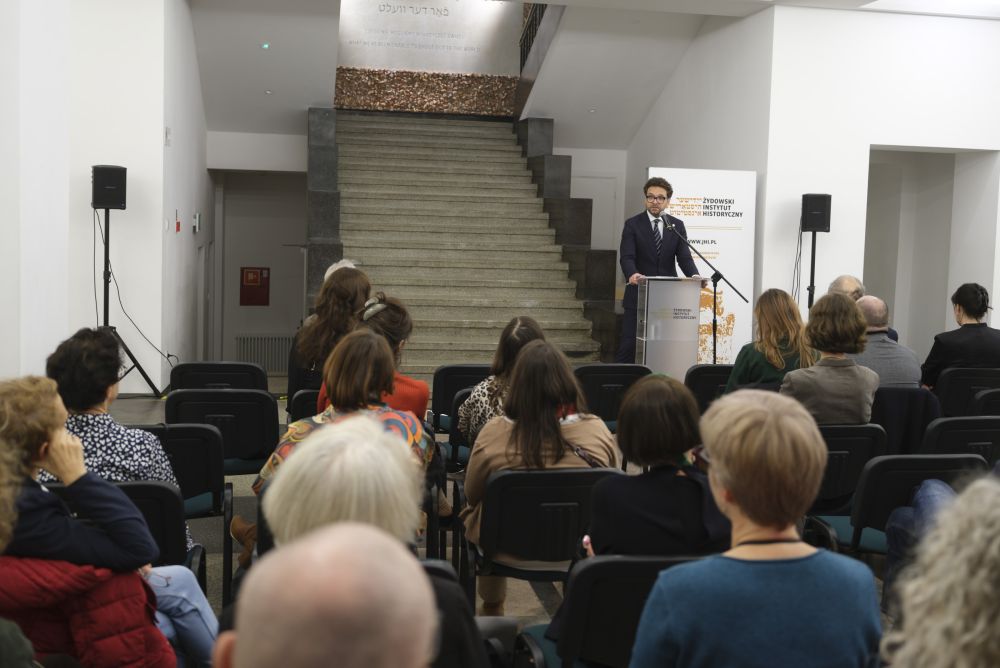
The guests at the ceremony – the prize winners and their close ones, as well as academic supervisors and reviewers of the dissertations – were welcomed by Dr Michał Trębacz, Director of the Jewish Historical Institute.
“This place has a symbolic meaning for our competition. The JHI seat used to house the Institute of Jewish Studies, co-founded by Majer Bałaban. And so, we are meeting in the same building where the namesake of the award taught subsequent generations of scholars. (…) The competition, whose twelfth edition concludes today, is an important element of the JHI’s mission. Our employees came up with the idea when the history of Jews in Poland ceased to be blank page and started to return to universities; when the history of Polish Jews started to become a part of the history of Poland.
Over the years, we have awarded dissertations penned by people who have gone on to develop the field of Jewish Studies in Poland. The prize winners include Professor Barbara Engelking, Professor Bożena Szaynok, Professor Eugenia Prokop-Janiec, and Professor Michał Galas. The subject field has changed as well. Today, the scholars do not deal just with history in the strict sense, but also with culture, literature, and memory. (…)
Majer Bałaban carried on his academic work even after moving to the Warsaw ghetto. He died in the Jewish quarter in late 1942. His seminar became history, but not the questions posed by him and his students. Today, they reverberate in Tłomackie through your research papers – and will remain here, in the same building which held prewar typescripts”, said Dr Michał Trębacz, Director of the Jewish Historical Institute.
Another speaker was Prof. Andrzej Żbikowski – Head of the Majer Bałaban Competition Jury:
“We are open to a wide range of themes, and I think that the more traditional dissertations – either historical or biographical – have received enough recognition. We are expecting to read very innovative papers, so cutting-edge you could hardly imagine what they discuss.”
The Jury of the 12th edition the Majer Bałaban Competition for best MA theses and PhD dissertations on Jews and Israel has presented the following awards:
In the PhD dissertation category, two awards ex equo:
dr Aleksandra Gluba, Sold: Polish and Jewish Narratives of Women’s Prostitution in Polish Lands from the Early 20th Century to 1939
The dissertation was written under the supervision of Prof. Joanna Degler.
The paper focuses on female prostitution and the associated phenomenon of human trafficking – an important social issue which left a visible mark in European literature. It became a major theme in the two national literatures developing in the Polish lands, namely in Polish literature and Yiddish literature. This is significant, since the Polish lands were the cradle of modern Yiddish literature on the global scale. The author aptly ties the growth of prostitution to industrialisation, mechanisation, and urbanisation. The dissertation is based on extensive source material skilfully selected and analysed by the author.
dr Katarzyna Kwiatkowska-Moskalewicz, “My dream is to build socialist Poland, a free homeland for free and happy people. But I am very afraid…” Identity and Political Dilemmas of Jewish Communists in Poland 1918–1968 – Study of a Double Disaster
The dissertation was written under the supervision of Prof. Irena Grudzińska-Gross (Institute of Art, Polish Academy of Sciences) and Prof. Grzegorz Skrukwa (Adam Mickiewicz University).
In this impressive dissertation, the author discusses an important, socially resonant, and culturally poignant subject in a mature, analytical manner. Choosing such a scope of research in itself necessitates confronting the discriminatory myth of “Judeo-communism”, still alive in society, which makes the author’s decision worthy of praise. The dissertation situates the studied actors in a broad landscape which illuminates the wider social, cultural, identity-related, and political context of their actions and choices. The research represents the field of social and cultural history, although it also (successfully) refers to the sphere of politics. This is a rare approach in Polish historical writing; it should be considered a harbinger of a new chapter in social historiography and an attempt at enriching the field’s tradition. The conceptual framework and structure of the dissertation are particularly commendable.
In the MA thesis category:
First Place: mgr Anna Darewska, Gathering the Spirit of the Jewish People. A National Ethnographic Project of the Authors of ‘Bay Unz Yuden. The Book of Folklore and Philology’ (1923)
The thesis was written under the supervision of Dr Monika Polit.
In her paper, the author presents an insightful analysis of the attempts made in the first two decades of the 20th century to build modern Jewish national community on the foundations of folklore, known as the National Ethnographic Project. She discusses texts which elucidate the views and ambitions of the folklorists associated with Yiddishist ideology. She shows that the case of the Jewish nation constituted a great challenge for scholars dealing with the national question, who emphasised the unique nature of the Jewish community which managed to preserve a sense of unity despite the lack of common territory and a single language. The thesis demonstrates that Yiddishists, following the example of folklorists from other European nations who sought national roots in folklore, postulated systematically collecting, studying, and promoting Jewish folklore. Their ambition was for folkloric research to help the Jewish nation to catch up to the “more civilised” nations or even to bring a Jewish nation to life.
Second Place: mgr Jakub Galas, The Talmudic Hogwarts. Speculative Fiction in Contemporary Hebrew Literature – A Study of Selected Works
The thesis was written under the supervision of Dr Anna Piątek.
The thesis discusses Israeli fantasy fiction, and its aim – as formulated by the author – is to define the genre of speculative fiction in Hebrew literature based on selected examples. The author traces the presence of fantasy elements in contemporary literature which refer to the traditional roots of Jewish culture. Mr Jakub Galas concludes that the sources of Jewish culture, such as the Bible, Talmud, and Hasidic literature, abound in supernatural stories in which the key role is played by superhuman powers; they are narratives of miracles, angels, and animals speaking in human voice. The thesis is innovative and presents in an insightful and imaginative manner a theme hitherto rarely explored by scholars.
***
In 2025, the JHI published the first work in the new “Bałaban” series. It comprises works on the history and culture of Jews recognised in the Majer Bałaban Competition. The first volume, Biblioteki żydowskie w Rzeczypospolitej. Z dziejów nowoczesnej kultury żydowskiej na ziemiach polskich [Jewish Libraries in Poland. From the History of Modern Jewish Culture in Polish Lands] by Monika Biesaga, has been widely acclaimed by critics. The book received nominations in three competitions organised this year.
____
On the namesake
Born in Lviv in 1877, Majer Bałaban was the first scholar to use modern scientific methods in the study of the history of Polish Jews. He believed – as demonstrated by the content of his books and articles – that the community of Jews in Poland was one of the most influential and creative in the history of Jewry worldwide.
During the First World War, he served in Lublin as a military rabbi. In the interwar period, he headed the Rabbinical Seminar in Warsaw, lectured at the University of Warsaw, and at the Institute of Jewish Studies – the latter’s tradition has been kept alive by the Emanuel Ringelblum Jewish Historical Institute, located in the same building. Even during the German occupation, when he lived in the Warsaw ghetto, Bałaban continued to conduct research. He died at the turn of 1943.
The Majer Bałaban Competition
The idea of the Competition was born at the Jewish Historical Institute during the political transformation in Poland. The early 1990s saw rising popularity of scholarly works discussing various aspects of the history of Jews in Poland. A number of academic centres started to conduct studies in the field, and the JHI became a place where scholarly papers were stored and shared with the public. Over the years, the thematic scope of the submitted research has grown and started to encompass not just history but also Jewish culture and memory of the multi-millennial presence of Jews in Eastern Europe.
Since 2009, the Competition has borne the name of Majer Bałaban, who was the first person to use modern scientific methods in the study of the history of Polish Jews. He believed that the community of Jews in Poland was one of the most influential and creative in the history of Jewry worldwide, a claim he sought to prove through his publications. His research on the Jews of Lviv, Kraków, and Lublin are still considered valuable sources of knowledge. Bałaban always emphasised the importance of studying Polish-Jewish history – both as an integral element of the global history of Jews and an essential part of the history of Poland.
The research initiated by Bałaban is still ongoing, as evidenced by the winning papers in the Competition.


